Medical “Back-Up” for Women on 30–90-Day Trips: Insurance, Telemedicine, Prescriptions and a Travel Kit
Trips that last one to three months sit in an awkward middle zone: long enough for “small problems” to become expensive (a cracked filling, a stubborn UTI, a migraine prescription you suddenly can’t refill), but short enough that many people still travel with a light mindset and a short checklist. If you’re working remotely and changing cities often, the risks aren’t dramatic — they’re practical. The goal of a medical back-up plan is simple: know who to call, what you’re covered for, and what you can safely carry, before anything happens.
Choosing insurance that matches remote work and frequent moves
Start by separating two types of cover that are often mixed together: “trip protection” (cancellations, lost baggage) and “travel medical” (treatment abroad). For a 30–90-day stay, the medical part is usually the one that saves you from the big bills. Look for clear wording on emergency treatment, hospitalisation, imaging, and repatriation. If you will be moving around, check whether the policy treats each border crossing as a new “trip” or whether it covers you continuously for the full dates you’ve bought.
Then look at the parts many women actually use. Dental is a common pain point: some policies cover emergency dental only (think infection relief), not repairs. Mental health is another grey area: many plans exclude ongoing therapy, while some offer limited sessions after an acute event. If you might want counselling while travelling, check whether it’s included, whether it must be arranged through the insurer’s assistance line, and whether it is capped by number of sessions or a low monetary limit.
Finally, be honest about activities. Policies often have an “adventure” or “sports” definition that can quietly exclude things you’d consider normal, like hiking at altitude, scuba diving, motorbike riding, or organised sport. If your travel routine includes climbing gyms, surfing lessons, ski weekends, or scooter commuting, read the activity list and buy the add-on rather than hoping the claim will be accepted.
A policy checklist that prevents the usual surprises
Check the excess (deductible) and how claims are handled. A low premium with a high excess can still be fine, but only if you can comfortably pay the first chunk of any bill. Also look for “direct billing” language: in many destinations you may need to pay upfront and claim back later, so plan for that cashflow. If direct billing is available, it usually works only when you contact the assistance number before treatment (unless it’s a genuine emergency).
Read the pre-existing condition section carefully, even if you feel well. Many policies treat any condition that required medication, monitoring, or treatment in a look-back period as pre-existing — that can include migraines, asthma, depression/anxiety, endometriosis, thyroid issues, or recurring UTIs. Some insurers cover stable conditions if you declare them and pay extra; others exclude anything linked to them. It’s not glamorous, but this single paragraph in the policy often decides whether a claim is paid.
Make sure the policy fits the way you travel. If you’re doing frequent short stays, check whether the insurer expects you to be “resident” in your home country at the start of the policy, and whether there are any rules about returning home. If you’re on a rolling itinerary, choose cover that doesn’t punish you for flexibility — and keep the emergency numbers saved offline, not just in an email.
Telemedicine: arranging care on the road and keeping data safe
Telemedicine has become a normal part of travel medical support: it’s useful for triage, prescription renewals where permitted, skin infections, stomach bugs, contraception questions, and “do I need urgent care?” decisions. Some travel medical policies include telehealth as a built-in service, while others reimburse remote consultations only if they are approved in advance. Either way, it’s worth setting up before you leave: download the app (if there is one), test the login, and confirm what countries you’ll be in, because service availability can vary.
Plan for time zones and connectivity. For a 30–90-day trip, you’ll probably need at least one appointment that is not an emergency — a repeat prescription, a flare-up of something chronic, or a review after a minor injury. Pick a consistent “home clinic” option: either your GP back home (if they offer remote appointments) or the insurer’s medical line, and decide who is responsible for follow-up if symptoms don’t improve. This avoids the stressful pattern of seeing a different clinician every time you change city.
Use telemedicine for smart escalation, not just reassurance. A good remote clinician can tell you what red flags to watch for, what over-the-counter options are safe with your usual meds, and whether you should go to a local pharmacy, urgent care, or the emergency department. In practice, this saves time and money — and it helps you avoid walking into the wrong part of the system in a country you don’t know.
How to store and share medical information without oversharing
Create a small “medical essentials” file that you can access quickly. Keep it short enough that you will actually maintain it: diagnoses that matter, allergies, current medications (with doses), emergency contacts, and any implanted devices. If you’re travelling with controlled medicines or anything that is often questioned at borders, add a scan/photo of the prescription and a brief clinician letter stating the medicine name, dose, and why you need it.
Think about what you share and where it lives. Avoid sending full medical histories over unsecured Wi-Fi or in unencrypted attachments. A practical approach is to store documents in a secure, password-protected location and share only what a clinician needs for the specific problem. If you need to show paperwork at a pharmacy or border, having clean photos in your phone (plus the originals in your bag) is often easier than hunting through email threads.
Backups matter more than perfection. Keep at least one offline option: a printed one-page summary in your passport wallet or a saved PDF that doesn’t require internet. If your phone is lost, your data plan fails, or you can’t log into an app, you still need to communicate quickly — especially in urgent care where every minute feels longer than it should.

Prescriptions and your travel kit: documentation, supply planning, and realistic packing
For prescription medicines, assume two things: rules vary by destination, and “common at home” doesn’t mean “allowed everywhere”. Some countries restrict specific ingredients, dose strengths, or quantities, and controlled substances can trigger extra scrutiny. The safest baseline is to travel with medicines in their original labelled containers, carry a copy of the prescription, and pack enough for the whole trip plus a small buffer for delays — in your hand luggage rather than checked baggage.
If you take anything that could be classed as controlled (certain strong painkillers, some sleeping pills, some ADHD medicines, some anti-anxiety medicines), do extra homework. Many national authorities limit quantities and require documentation. For a 30–90-day itinerary, it’s sensible to ask your prescriber for a letter that lists the generic name, your dose, your travel dates, and that the medicine is for personal use. If your trip crosses several borders, check each country’s rules — the strictest one is the one that matters.
Plan refill scenarios before you need them. If you rely on hormonal contraception, migraine medication, asthma inhalers, thyroid medication, antidepressants, or any medicine where stopping suddenly is risky, decide how you would handle a lost supply: who can send a replacement, whether your insurer’s telehealth can issue a local prescription where legal, and whether you can access a pharmacy chain in multiple cities. In the EU, prescriptions and reimbursements have specific cross-border rules, but you still need to budget for paying upfront in many cases.
Two kits that cover most situations: “minimum” and “chronic conditions”
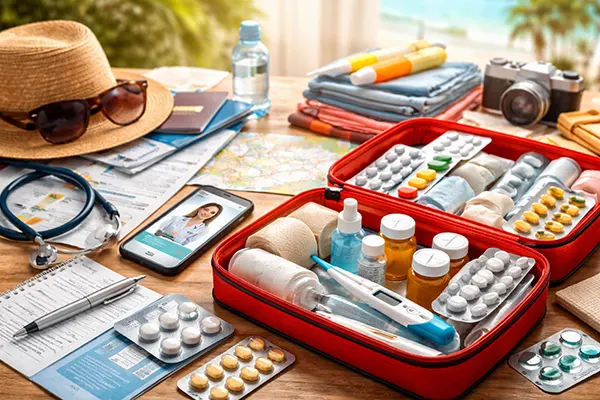
The minimum kit is about pain, stomach issues, minor wounds, and prevention. A sensible set for most trips includes: plasters of a few sizes, blister care, antiseptic wipes, a small roll of bandage, tweezers, a digital thermometer, oral rehydration salts, an anti-diarrhoeal medicine, an antihistamine, and a basic painkiller you personally tolerate. Add a small supply of any personal essentials that are annoying to replace abroad (for example, specific period products or a preferred lubricant if you’re prone to irritation).
Add women-specific practicalities based on how your body behaves when routines change. If you are prone to UTIs, pack the items your clinician recommends and know when you must seek medical care (fever, flank pain, pregnancy, persistent symptoms). If you get thrush after antibiotics or stress, pack an appropriate treatment and avoid guessing with random products in unfamiliar pharmacies. If you have migraines, pack the medicine you know works plus your “rescue” plan: hydration, electrolytes, and a way to control light.
The chronic-conditions kit is personal and should be built around continuity. Pack all regular medicines for the full period plus extra for travel disruption, and split them between two bags so a single lost bag doesn’t wipe you out. Keep a written medication list with generic names (brand names change by country), and include any consumables you may not easily find: spare inhaler spacers, glucose monitoring supplies, EpiPens, compression socks, or topical treatments. This kit isn’t about packing more — it’s about avoiding a situation where you have to improvise under pressure.